A gold chain you no longer wear, a single earring whose partner is long gone, a class ring, a bracelet with a broken clasp: most gold jewelry is sold for its metal. That makes gold the most predictable kind of jewelry to sell, because its value starts with two things you can check yourself before you speak to anyone, the karat and the weight.
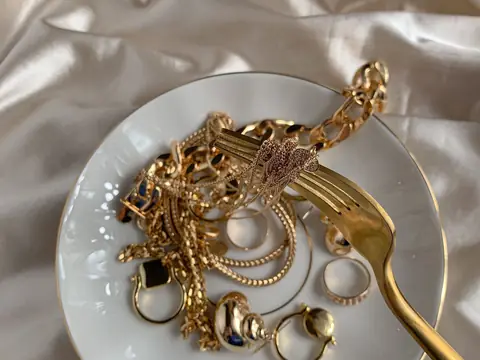
This page explains how to sell gold jewelry well: how to read the karat stamp, what each karat means in pure gold, how a buyer weighs and prices the metal, what happens to stones set in gold, and how to compare offers so you know a fair one when you hear it. The same rules apply to chains, necklaces, rings, bangles, bracelets and earrings.
Best Place To Sell Jewelry is an independent referral service, not a buyer, pawnshop or dealer. When you call or send the form, we pass your request to an independent buyer in New York, who makes any offer, and you are free to say no.
Have gold jewelry to sell? Call and describe it, or send the short form on this page.
Start with the karat stamp
Look inside a ring’s band, on the clasp or the tag near the clasp of a chain, on the post or back of an earring, and on the inside of a bangle. Gold jewelry is often stamped with its karat: 10K, 14K, 18K or 22K, sometimes written as 14 Kt. or 14KT. A loupe or a phone camera on zoom makes small stamps easier to read.
The stamp matters because of how US law treats the word. Under the Federal Trade Commission’s Guides for the Jewelry, Precious Metals, and Pewter Industries (16 CFR Part 23), the word “gold” on its own means fine, 24 karat gold. Gold alloy, anything under 24 karat, should carry a correct karat designation in front of the word, as in “14 Kt. gold”, and 14 karat should not be described as “solid gold”.
What each karat means in pure gold
Karat is a share of 24. Pure gold is 24 karat, so the gold content of any piece is its karat divided by 24. The rest of the metal is an alloy of other metals that gives the piece its hardness and color.
| Karat stamp | Share of pure gold | What it means for value |
|---|---|---|
| 10K | 41.7% | Less than half of the metal is gold |
| 14K | 58.3% | A little more than half of the metal is gold |
| 18K | 75% | Three parts gold to one part alloy |
| 22K | 91.7% | Eleven parts gold in every twelve |
| 24K | 100% | Fine gold, what “gold” alone means |
The share is what a buyer pays for. Two chains of the same weight, one 10K and one 18K, hold very different amounts of gold: the 18K chain has 75% gold by weight, the 10K chain 41.7%. The 10K versus 14K gold article works through the difference in more detail.
Allowed tolerance
The National Stamping Act, cited in the same FTC guides, allows a small margin. Gold with no solder may be up to three parts per thousand under its marked fineness; an item with solder may be up to seven parts per thousand under. A clasp or a soldered joint can pull the average down slightly, which is one reason to ask a buyer what karat they are paying for and how they confirmed it.

When the stamp says plated, it is not solid gold
Some markings mean the piece is not solid gold at all. The FTC guides reserve terms such as “Gold Plate”, “Gold Plated”, “Gold Overlay” and “Rolled Gold Plate” for a layer of gold alloy of at least 10 karat over another metal, with the plating’s karat stated before the term. A stamp such as “1/40 12 Kt. R.G.P.” describes rolled gold plate, not a 12 karat piece.
Plated items are not solid gold, and their thin gold layer holds very little gold. If you are unsure what a mark means, the how to tell if jewelry is real gold article covers the common markings and the simple checks people use at home.
How gold jewelry is weighed
Gold is priced by the troy ounce, not the kitchen ounce. According to NIST Special Publication 811, one troy ounce is 31.10348 grams, while an ordinary avoirdupois ounce is 28.34952 grams. A troy ounce is heavier. Jewelers and buyers also use the pennyweight (dwt), which is 1.555174 grams, one twentieth of a troy ounce.
Weights are often given in grams or pennyweight and converted. To turn grams into troy ounces, divide by 31.10348. A 15.55 gram bracelet, for example, is about half a troy ounce of metal before the karat is taken into account.
In New York City, the scale is regulated
A business that buys gold in New York City must have a scale and tell you the troy weight of the metal (6 RCNY 3-81). The scale must be a type approved by the New York State Department of Agriculture and Markets, read in steps of 0.01 troy ounce or smaller, and be marked Class II or III.
Weighing at home first
A small digital kitchen or postal scale that reads in grams gives you a rough figure before you sell. It will not match a certified scale to the hundredth, but it tells you whether a buyer’s weight is in the right range. Weigh each piece separately, write the weight next to its karat, and keep the list with you.
How a buyer figures what your gold is worth
The value of the gold in a piece, often called melt value, is simple arithmetic:
Melt value
Weight in troy ounces x gold share (karat / 24) x the spot price of gold per troy ounce.
Take a 14K chain that weighs one troy ounce. Its gold share is 58.3%, so it holds 0.583 troy ounces of pure gold. If the spot price of gold is X dollars per troy ounce, the gold in the chain is worth 0.583 x X dollars. The spot price changes through every trading day, which is why this site prints no prices: check a live price on the day you sell.
Melt value is the value of the pure metal only. A buyer’s offer is usually below melt because the buyer pays to refine the metal and needs a margin to stay in business. That gap varies between buyers, which is exactly why it is worth getting more than one offer and asking each buyer to show the weight and karat they used.
Why an offer is lower than what you paid in a store
A retail price includes the store’s costs, its labor and its margin. A buyer pays what a piece is worth to them to resell or melt. For plain gold jewelry, the metal value is the figure to compare against. Comparing an offer to the receipt from the store where the piece was bought tells you little; comparing it to the melt value tells you a lot.
Chains, necklaces, rings, bracelets and earrings
Every kind of gold jewelry is weighed the same way, but each has its own details worth knowing before you sell.
- Chains and necklaces. Clasps are sometimes a different karat from the chain or are plated steel springs. A buyer may weigh the clasp separately. Hollow chains are lighter than they look, so do not judge by size.
- Rings. The stamp is inside the band. Class rings, wedding bands and signet rings are often sold for metal. Rings set with diamonds are a different case: see below.
- Bracelets and bangles. Heavy bangles hold a lot of gold for their size. Link bracelets can contain a steel spring in the clasp, which a buyer may deduct.
- Earrings. A single earring has the same gold value as one of a pair. Backs are often unmarked and may be a different metal.
- Broken and tangled pieces. A knotted chain or a snapped link weighs the same as a whole one. The scrap gold page covers selling broken gold.

Stones set in gold
When a gold piece holds stones, a buyer has three choices: value the stones separately, ignore them, or deduct their weight from the metal. Ask which one they are doing. Small accent stones may simply be deducted as weight, so ask. A larger diamond, or a piece with a grading report, deserves its own valuation.
If your gold jewelry carries a diamond of any size, read the page on where to sell diamond jewelry before you accept an offer based on metal alone.
When a gold piece is worth more than its metal
Some gold jewelry sells as a piece rather than as metal: a signed designer bracelet, a period brooch, a piece with fine handwork or an unusual design. A buyer who can resell it as jewelry may pay more than melt. Signed pieces are covered on the page for designer jewelry, and inherited or antique gold on the page for estate jewelry.
Getting ready to sell gold jewelry
- Sort the pieces by karat, keeping 10K, 14K, 18K and 22K apart, and set aside anything marked as plated.
- Weigh each pile in grams and write the totals down.
- Separate pieces with diamonds or colored stones, and any signed or antique pieces, from plain gold.
- Work out a rough melt value for each karat with the formula above and the day’s spot price.
- Bring photo ID. In New York City, a licensed buyer must record the type and number of your ID and you sign in front of them.
- Ask for a written offer that lists each karat group, its weight and the price per gram or pennyweight.
Comparing offers safely
Because gold is weighed and tested, you can compare two offers on equal terms if both buyers show you their numbers. Ask for the troy weight; in New York City, a licensed buyer must tell you. Ask the buyer to state the weight and karat they are paying for. An offer that only gives one total, with no weight, gives you nothing to compare.
In New York City, a business that buys used jewelry must hold a Secondhand Dealer General licence from the Department of Consumer and Worker Protection (DCWP), post the licence where customers can see it, and print the licence number on receipts. You can ask to see it. The jewelry buyers page explains what else a licensed buyer must do and the red flags to walk away from.
Know the karat and the weight? Call, and we connect you with an independent New York buyer.
Taxes
A profit on a sale can be taxable. The IRS says net capital gains from selling collectibles, such as coins or art, are taxed at a maximum federal rate of 28% (IRS Topic No. 409). Most small sales of jewelry are not reported by the buyer on Form 1099-B, but your own obligations depend on your situation, so ask a tax professional.
Questions people ask
What is the best place to sell gold jewelry?
The best place is a buyer who weighs your gold on an approved scale, tells you the weight and karat, and puts the offer in writing so you can compare it. For plain gold, an offer works from metal value; for signed or antique pieces, someone who resells jewelry as jewelry may pay more.
Is it worth selling old gold jewelry?
Gold keeps its metal value whether a piece is in fashion, broken or missing its partner, so old gold jewelry is worth something as long as it is solid gold. Work out the rough melt value first so you know what the gold is worth before you hear an offer.
Is 10K gold worth selling?
Yes. 10K is 41.7% gold, so it is worth less per gram than 14K or 18K, but it is real gold and is priced by weight like any other karat.
Do I need to remove the stones before selling?
No. Bring the piece as it is and ask the buyer how they are treating the stones: valued separately, ignored, or deducted from the gold weight. Larger diamonds deserve their own valuation.
What should I bring when I sell gold jewelry?
Government-issued photo ID with your signature, the pieces sorted by karat, your own weights, and any receipts, appraisals or grading reports for stones.
Can a minor sell gold jewelry?
Not in New York City: a licensed secondhand dealer cannot buy used items from a minor (NYC Admin. Code 20-268).
Ask about a piece